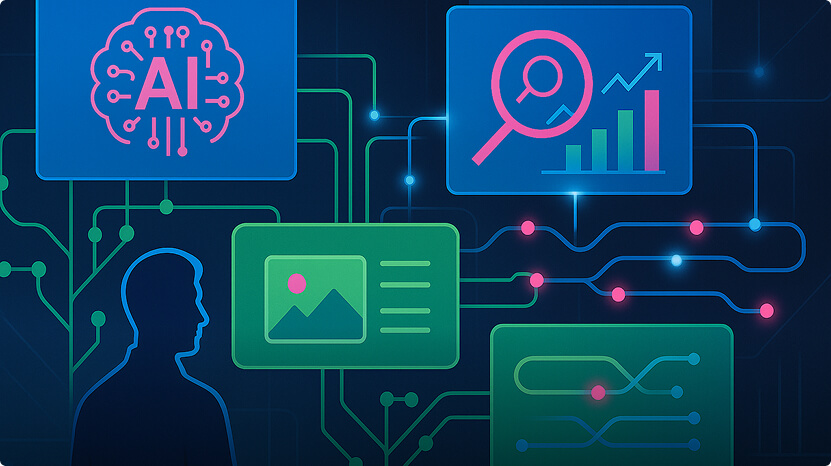
I’ve seen how quickly artificial intelligence has moved from a novelty to a necessity in digital marketing. What used to take hours of manual effort — keyword research, ad copywriting, audience targeting, performance analysis — can now be supported, enhanced and in some cases transformed entirely by AI tools.
For small business owners, this shift is incredibly important. You may not have a full marketing team or unlimited budget, but AI gives you leverage. Used correctly, it allows you to operate with the sophistication of a much larger organisation while maintaining the agility that makes small businesses so effective.
The key, however, is understanding how to use these tools strategically rather than relying on them blindly.
From Manual Marketing to Assisted Decision Making
One of the biggest changes I explain to clients is that AI is not here to replace marketing strategy. It is here to support it.
In PPC and paid social campaigns, AI can now assist with everything from generating ad variations to predicting which audiences are most likely to convert. Platforms themselves are increasingly AI-driven, with automated bidding, audience expansion and creative optimisation built in.
For a small business owner, this means you are no longer starting from scratch. You can use AI to accelerate campaign setup, test ideas quickly and uncover insights that would otherwise take significant time and expertise to identify.
However, the danger lies in over-reliance. AI can generate options, but it cannot understand your business the way you do. The most successful campaigns come from combining AI efficiency with human judgement.
Using AI to Improve Creative and Messaging
One of the most practical ways small businesses can leverage AI is in creative development. Writing ad copy, developing headlines and testing different messaging angles can be time-consuming. AI tools can generate multiple variations in seconds, giving you a strong starting point.
From my experience, the real value is not in using the first output, but in refining it. AI can suggest structures, highlight angles and spark ideas, but your role is to ensure the messaging aligns with your brand, speaks to your audience and reflects your unique selling points.
In social campaigns, this becomes even more powerful. AI can help generate captions, hooks and variations tailored to different audience segments. When combined with platform-level optimisation, this creates a dynamic environment where your messaging is constantly being tested and improved.
Audience Targeting and Data Interpretation
Another area where AI has transformed PPC and social campaigns is audience targeting. Platforms now use machine learning to identify patterns in user behaviour, allowing campaigns to reach people who are more likely to convert even if they do not fit traditional targeting criteria.
For small businesses, this is a major advantage. You no longer need to rely solely on assumptions about your audience. Instead, you can feed the system with data — website visitors, customer lists, engagement signals — and allow it to find similar users.
AI also helps with interpreting performance data. Rather than manually analysing large datasets, you can use AI to identify trends, anomalies and opportunities. This allows you to make faster, more informed decisions about where to allocate budget and how to optimise campaigns.
Balancing Automation with Control
One of the most important lessons I’ve learned is that while AI can handle a lot, it still requires oversight.
Automated bidding, creative optimisation and audience expansion can deliver strong results, but they need the right inputs. Clear goals, accurate tracking and well-structured campaigns are essential. Without these, AI systems can optimise in the wrong direction.
For small business owners, this means maintaining a level of control. Understand what your campaigns are trying to achieve, monitor performance regularly and be prepared to intervene when necessary. AI should enhance your strategy, not replace it.
Why This Is a Game Changer for Small Businesses
The reason I’m so optimistic about AI tools is that they lower the barrier to entry. In the past, running effective PPC and social campaigns required significant expertise and time investment. Today, small businesses can achieve strong results with fewer resources, provided they approach AI strategically.
This creates an opportunity to compete more effectively, reach new audiences and scale campaigns without dramatically increasing costs. It also allows for faster experimentation, which is critical in a constantly changing digital landscape.
Small businesses that embrace AI early and learn how to guide it will be in a far stronger position than those who resist or misuse it.
How I Approach AI-Driven Campaigns
At SEO North Sydney, I treat AI as a powerful tool within a broader strategy. I use it to accelerate processes, generate insights and enhance campaign performance, but always within a structured framework.
This means ensuring that tracking is accurate, goals are clearly defined and campaigns are aligned with business objectives. From there, AI can be used to refine and optimise, rather than guess and experiment blindly.
By combining AI capabilities with strategic oversight, I help small business clients achieve consistent, scalable results across PPC and social channels.
Why Now Is the Time to Start Leveraging AI
AI is no longer optional in digital marketing. It is already embedded in the platforms you are using, and its influence will only continue to grow.
For small business owners, the opportunity is clear. By learning how to use AI tools effectively, you can improve efficiency, enhance performance and compete at a higher level without needing a larger team or budget.
The businesses that succeed will not be those that rely entirely on automation, but those that understand how to guide it. If you want help integrating AI into your PPC and social strategy, contact SEO North Sydney today and let’s build a smarter, more effective campaign together.