One of the biggest advantages of digital marketing is that we can test what works instead of relying entirely on assumptions. I have always considered this particularly important for small businesses because their marketing budgets are usually much tighter than those of large organisations.
Google is now giving advertisers more ways to test changes to Search campaigns and AI Max before applying them more broadly. New experimentation capabilities allow businesses to compare different budgets, return on investment targets and campaign settings, while also testing AI Max with controls around brands and locations.
As the owner of SEO North Sydney, what interests me most is not simply whether these tools can improve Google Ads performance. The real opportunity is using the information generated by paid search experiments to make better decisions across SEO, content and the wider digital marketing strategy.
Stop Guessing And Start Testing
I think small businesses can fall into the trap of making a change to Google Ads and then assuming the result tells them whether the change worked.
For example, a business might increase its advertising budget and see more conversions the following month. It might then conclude that increasing the budget was successful.
But what if demand was already increasing? What if a competitor reduced its advertising? What if the additional conversions came at a significantly higher cost?
An experiment gives you a much stronger basis for making that decision.
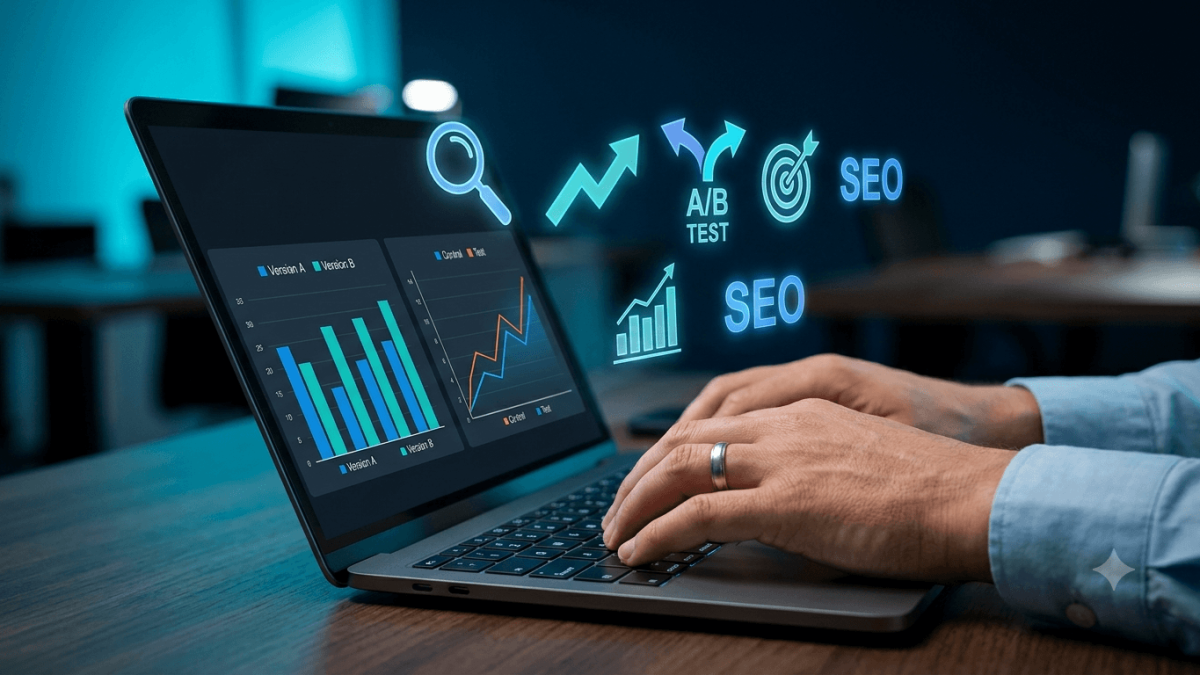
Instead of changing an entire account and hoping for the best, you can compare a test against a control and examine what actually happened.
That is a much healthier approach to both PPC and SEO.
Test Before Increasing Your Budget
One of the most useful applications for a small business is testing whether additional advertising spend is genuinely producing additional business.
It is very easy to assume that doubling a Google Ads budget should produce approximately twice as many leads.
In reality, the relationship is rarely that simple.
Your highest-intent searches may already be receiving most of the available exposure. Increasing the budget may simply push you into less valuable searches or increase the cost of acquiring customers.
The new testing capabilities allow advertisers to investigate the impact of budget changes across multiple Search campaigns rather than making a wholesale change without evidence.
For a small business, this is particularly valuable because every additional dollar needs to justify itself.
AI Max Needs To Be Tested, Not Blindly Accepted
AI Max is another area where experimentation becomes important.
Google is increasingly using AI to expand how Search campaigns find potential customers, match queries and optimise advertising performance.
There is an obvious attraction to this. A machine can identify patterns and potential searches that a business owner may never have considered manually.
But greater automation also means giving Google more control over how your advertising reaches people.
I would therefore test AI Max rather than simply turning it on across an entire account and assuming the results will be better.
The new experimentation capabilities make it easier to compare AI Max performance while retaining important brand and location controls.
For a local business, those controls can be particularly important.
Local Businesses Need To Protect Geographic Relevance
Location is one of the areas where small businesses need to be particularly careful.
A Sydney business does not necessarily benefit from generating enquiries from Melbourne, Brisbane or overseas simply because Google can find additional potential traffic.
More traffic is not automatically better traffic.
For a local service business, the quality of the enquiry matters considerably more than the raw number of conversions reported inside Google Ads.
This is why I would use experimentation to understand whether expanding targeting actually produces more qualified customers rather than simply more activity.
The same principle applies to SEO. Ranking for searches outside your service area may increase impressions while contributing very little commercially.
PPC Testing Can Inform SEO
This is where I think small businesses can gain a significant advantage.
Google Ads provides immediate information about search behaviour. If a particular query consistently generates strong conversion rates from paid traffic, that can tell you something about its commercial value.
I can then examine the business’s organic visibility for the same search.
Perhaps the company is paying for every click despite already having a strong organic ranking. Perhaps it has no organic presence and should consider building a dedicated SEO landing page. Perhaps it ranks organically but the page does not convert effectively.
Paid search therefore becomes a testing ground for SEO opportunities.
Rather than spending months developing content around a keyword simply because a keyword tool says it has search volume, I can use real advertising data to understand whether the underlying intent appears commercially valuable.
Use Experiments To Improve Landing Pages
The connection between PPC and SEO also extends to landing pages.
Suppose a Google Ads experiment identifies a particular service as generating strong engagement but poor conversion rates. The problem may not be the advertising itself.
The landing page could be unclear, poorly structured or failing to communicate why the customer should choose the business.
That is simultaneously a PPC problem and an SEO problem.
A page that is difficult to understand or fails to satisfy the visitor is unlikely to be an ideal organic landing page either.
Improving the page can therefore benefit both channels.
Measure Business Outcomes, Not Just Platform Metrics
I would be particularly cautious about relying solely on the metrics presented by Google Ads.
Clicks, impressions and conversions are useful, but they are not the same as profitable customers.
A small business should understand what happens after the lead is generated.
If one campaign produces fifty leads but most are poor quality, while another produces fifteen leads that regularly turn into customers, the second campaign may be substantially more valuable.
This is another area where SEO and PPC should be connected with the actual business.
Organic traffic, paid traffic and conversion data should ultimately be judged against enquiries, sales, bookings and revenue.
Experiments Can Reveal Where SEO Should Invest
I think one of the most valuable uses of PPC experimentation is deciding where not to spend SEO resources.
SEO takes time. If I am building a new landing page, writing supporting content and developing authority around a topic, I want reasonable evidence that the subject is commercially worthwhile.
Google Ads can provide that evidence relatively quickly.
It does not mean every profitable PPC keyword automatically deserves an SEO campaign. Competition, organic difficulty and search intent still matter.
However, when paid search data, organic visibility and business conversion data point in the same direction, I have considerably more confidence in the opportunity.
Small Businesses Should Build A Testing Culture
The bigger lesson I take from Google’s new experimentation tools is that small businesses should become more comfortable with controlled testing.
Do not increase every budget at once. Do not activate every automated feature across every campaign. Do not assume a new strategy works simply because the first few weeks look positive.
Test changes, compare results and understand what happened before committing more money.
I would apply exactly the same philosophy to SEO.
Test new landing page structures. Test internal linking approaches. Test different content strategies. Measure what happens and use the information to decide what deserves further investment.
SEO and PPC do not have to operate as separate marketing departments. They can provide information that improves each other.
AI Makes Measurement More Important, Not Less
Google’s increasing use of AI means advertisers are gaining access to more automation, but that does not mean business owners should become less analytical.
Quite the opposite.
The more control Google takes over targeting, bidding and optimisation, the more important it becomes to understand whether the outcomes actually benefit the business.
For me, experimentation is the answer.
AI can find opportunities that I might miss, but testing tells me whether those opportunities are genuinely worthwhile.
That is particularly powerful for small businesses. You do not need the largest advertising budget or the biggest SEO team if you are making better decisions with the data available to you.
Google’s new Search and AI Max experimentation tools therefore represent more than another PPC feature. Used properly, they can become part of a broader evidence-based marketing strategy.
I would use paid search to discover demand, experiments to validate opportunities and SEO to build sustainable visibility around the searches that have demonstrated genuine value.
That combination gives small businesses something far more useful than simply more traffic. It gives them a way to make increasingly informed decisions about where their marketing money and time should go.
If you want to connect your Google Ads testing with a data-driven SEO strategy, contact SEO North Sydney and I can help identify which search opportunities are worth investing in for long-term growth.